Projects Accomplished – Selection from Employed & Freelance Work
Reference Projects -- Overview
Click to see more details
DfT Expert Community and DfT Implementation Standard
- Driving companywide standardisation of ‘Best-Known-Methods’ in IC Design-for-Test
- Establishing a DfT expert community to continuously drive improvement process
- Results: Increased productivity and significant quality improvement through sharing and reuse of BKM’s
Reduced production test release time for 'first silicon'
- Fostered multi-disciplinary process improvements and new technical solutions
- Introduced pre-Si verification methodologies into production test content verification
- Results: Production test release time reduced from 4-6 weeks to 1-2 days
On-chip calibration solution for qualification of RF-Transceivers
- Setup and manage project to enable IC calibration in qualification environment
- Define overall calibration concept, including on chip calibration data access and pre-processing
- Develop software in Python for test case automation and post-silicon verification
- Results: On-chip RF-Transceiver calibration worked “out-of-the-box”
Test benchmarking to increase manufacturing throughput
- Problem Statement: Unexpectedly long test times and higher‑than‑anticipated demand for a new product family created a severe test‑capacity bottleneck
- Identified products with similar functionality and existing or upcoming manufacturing bottlenecks across different product devisions
- Analysed test content and corresponding test times (profiling) in detail to identify directly comparable test groups across products from different business divisions
- Made ‘Best-Known-Methods’ (BKM) transparent to development teams across different organisations
- Results: Identified significant test time and throughput improvements based on BKM’s
Roles, responsibilities and related bottlenecks
- Problem statement: test content often non-functional when first silicon arrives, test development and availability of first tested samples significantly delayed
- Detailed interviews throughout all hierarchy levels revealed unclear responsibilities and unrealistic expectations between IC design and test development organisations
- Knowledge and bandwidth gaps identified for relevant interface functions, i.e. lack of dedicated headcount and insufficient expertise for critical tasks
- Results: Established DfT expert team at interface between IC design and test development; updated and widely communicated process improvements regarding responsibilities
Test concept review for first product in advanced technology
- Problem statement: external risk assessment required to review manufacturing test concept for product with many ‘first time’ challenges
- Detailed assessment of intended DfT, pattern development, and test concept, as well as project timeline and headcount planning
- Matched assessed plan and state of actual implementation with known industry best practice for a product with similar complexity
- Results: Detailed feedback to implementation and management team: what is sufficient, what needs additional attention, what risks require dedicated management attention, e.g. underestimated headcount demand for design and intended manufacturing flow
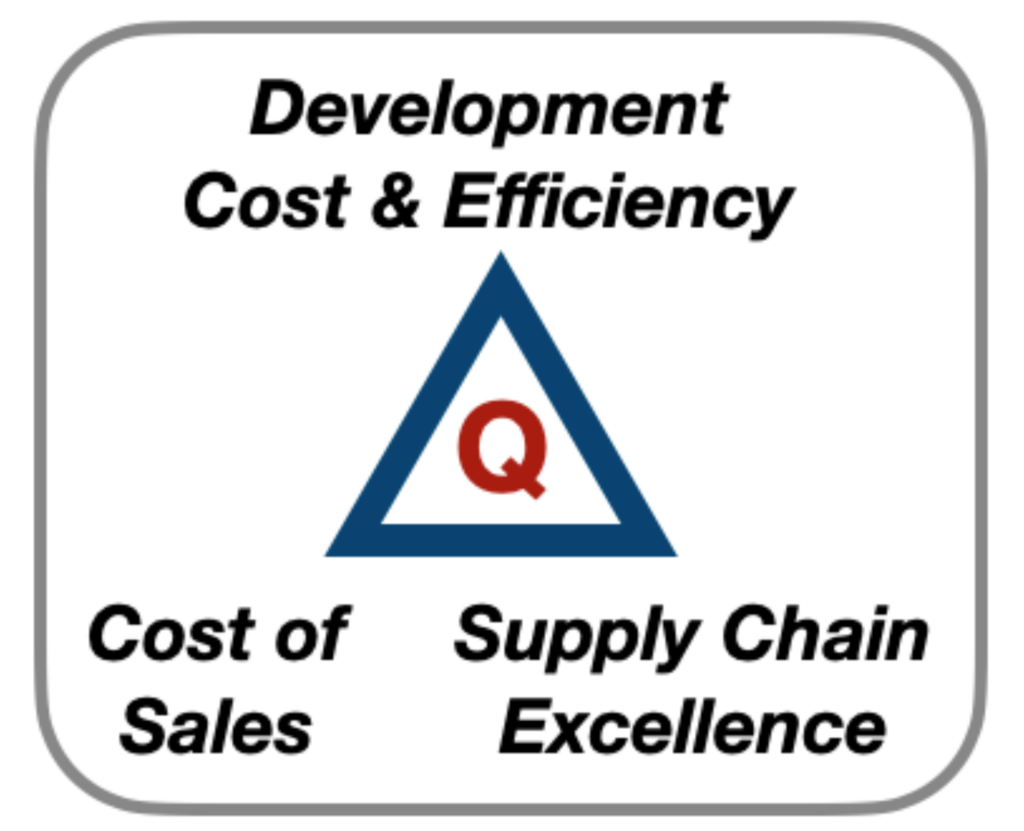
Consulting projects nearly always balance three, usually conflicting aspects:
Test Development Cost & Development Efficiency,
Manufacturing Test Cost (Cost of Sales),
Flexibility in delivery capabilities (Throughput or Supply Chain Excellence),
while IC Quality (‘Q’) is usually non-negotiable and is given by market conditions, e.g. 0ppm for automotive applications.